Piotr Mitros
 piotr@mitros.org
Piotr Mitros is an innovator and expert in the field of
education. He has been a co-founder or key early employee at
three organizations, all of which have crossed the $100 million
mark. Mitros is a frequent keynote speaker, panelist, and
consultant on: disruption in education, assessment, learning
analytics, educational datamining, open educational resources,
learning-at-scale, open education, use of evidence in education,
ICT for development, and crowdsourcing in education.
When not traveling, Mitros is focused on a new not-for-profit
targeting access to justice, civics, and open education. He
is a candidate for the
Cambridge School Committee, where he hopes to use his experience
in education research and in cross-cultural education to improve
the Cambridge School District. He also enjoys consulting when
particularly technically interesting or socially-beneficial
projects come up.
Mitros is a free software author, best known as the creator of
Open edX, an educational platform which has around 300
contributors, and 200 deploys, including ones from
the Saudi
Ministry of Labor, the Ministries of Education
in France,
and China,
and the Queen Rania Foundation (the not-for-profit of the Queen
of
Jordan), Stanford,
the World
Economic Forum, as well
as edx.org. As of this
writing, it powers around 1,000 full, pure-online courses, has
around 10 million users, and forms the backbone of a new
research ecosystem. Designed from the ground up for educational
data collection, randomized control trails, and experimental
pedagogies, at the most
recent Learning@Scale
conference, all but one of the best paper nominees
(including the winner) were based on Open edX. Mitros proposed
the concept of MITx/edX to MIT in the fall of 2011, and served
as the Chief Scientist of edX, the MIT/Harvard education
initiative, for over a half-decade.
Mitros has a long history developing educational models,
especially in diverse cultures. The concepts behind the MITx
project were inspired by Mitros' experiences teaching in China,
working in India, facilitating educational technology projects
in Nigeria, and developing experimental educational formats at
MIT. His observations of university systems around the world
inspired Mitros to find innovative ways to dramatically
increase both the quality of and access to education. He has
pioneered several models by which groups of students and
educators can work together to construct courses with improved
learning outcomes, pioneered many ways to use technology to
improve learning outcomes in classrooms for diverse
populations, and did extensive data analysis on one of the
largest psychometric datasets in the world. His pedagogies and
technologies have enabled improved learning outcomes across an
incredible diverse range of settings, backgrounds, and
cultures.
Mitros briefly served as Director for Education at what was at
the time Know Labs and is now Udacity. Udacity was valued at
over $1 billion at its last investment round. Mitros developed
the analog electronics for a new medical imaging modality for
Rhythmia Medical. The resulting device (which also includes
novel numerical algorithms, data visualization, mechanical
design, etc. developed by other members of the Rhythmia team)
can remotely image the surface of the heart, shaving hours off a
particular type of atrial surgery, and dramatically increasing
its accuracy. Rhythmia Medical sold for around $200 million and
the Rhythmia catheter and patient interface unit have been used
on thousands of patients saving many lives. As part of his work
at Rhythmia, Mitros designed what is still most likely the
highest-performance ECG circuit in the world.
Mitros is author of many peer-reviewed scientific
publications, and holds a B.S. degrees in Math and in Electrical
Engineering, a Masters of Engineering in EECS, and a Ph.D. in
EECS, all from MIT, with which he has been continuously
affiliated in some way since he was a junior in high school.
Hobbies and interests
How people learn, how computers learn (machine learning),
anthropology, analog circuit design, digital circuit design,
computer science, control systems, applied mathematics,
transformational leadership, disruptive innovation. Areas of some
background: physics (classical mechanics, waves, thermodynamics,
and introductory quantum), signal processing, machining,
wood-working, welding, soldering, sewing, bicycling, martial arts,
Chinese (intermediate), Arabic (extreme beginner, despite
countless hours invested).
Piotr Mitros: Scholarly Works
Curriculum vitæ. roughly translated, means course of
my life. That suggests, if you'd like to know my life experience
— what it really means to be me — there are few
better places to look than this automatically generated page
listing my talks, publications, and research interests.
Conference and Journal Publications
- 2016 Dede, Ho, Mitros “Big Data Analysis in Higher Education: Promises and Pitfalls.” Educause Review.
- 2016 Mitros “Filters with Decreased Passband Error.” IEEE Transaction on Circuits and Systems II
- 2016 Sivaraman, Yoon, Mitros. “Simplified Audio Production in Asynchronous Voice-Based Discussions.” 34th ACM CHI Conference on Human Factors in Computing Systems
- 2015 Li, Mitros. “Learnersourced Recommendations for Remediation.” IEEE International Conference on Advanced Learning Technologies
- 2015 Mitros. “Learnersourcing of Complex Assessments.” ACM Learning at Scale.
- 2014 Mitros, Sun. “Creating Educational Resources at Scale.” IEEE International Conference on Advanced Learning Technologies
- 2014 Kim, Guo, Seaton, Mitros, Gajos, Miller. “Understanding In-Video Dropouts and Interaction Peaks in Online Lecture Videos.” ACM Learning at Scale.
- 2014 Mitros, Agarwal, Parachuri. “Assessment in Digital At-Scale Learning Environments”. ACM Ubiquity. (invited paper)
- 2013 Seaton, Bergner, Chuang, Mitros, Pritchard. “Who Does What in a Massive Open Online Course?” Communications of the ACM
- 2013 Mitros*, Parachuri*, Rogosic, Huang. “An Integrated Framework for the Grading of Freeform Responses.” Learning International Networks Consortium.
- 2013 Seaton, Bergner, Chaung, Mitros, Pritchard. “Massive Open Online Courses: a New Window on Education.” Learning International Networks Consortium.
- 2013 Mitros, Afridi, Sussman, Terman, White, Fischer, Agarwal “Teaching electronic circuits online: Lessons from MITx's 6.002x on edX.” IEEE International Symposium on Circuits and Systems
- 2008 Mitros. “Constraint modules: An introduction.” IEEE International Symposium on Circuits and Systems
Other Publications
- 2017 Nye, Mitros, Schunn, Foltz, Gasevic, Katz. “Why Assess: The Role of Assessment in Learning, Science, and Society.” Chapter in upcoming book Design Recommendations for Intelligent Tutoring Systems: Volume 5 - Assessment
- 2017 Baker, Mitros, Goldberg, Sottilare “Assessing Individual Learner Performance in MOOCs.” Chapter in upcoming book Design Recommendations for Intelligent Tutoring Systems: Volume 5 - Assessment
- 2017 Contributor to: “Big Data in Education: Balancing the Benefits of Educational Research and Student Privacy: Learning Process Data in Education.” National Academy of Education (final report)
- 2017 Brend, Littlejohn, Kern, Mitros, Shacklock, Blakemore. “Big data for monitoring educational systems.” Luxembourg: Publications Office of the European Union
- 2016 O Santos, J Boticario, C Romero, M Pechenizkiy, A Merceron, P Mitros, J Luna, C Mihaescu, P Moreno, A Hershkovitz, S Ventura, M Desmarais (Eds) “Proceedings of the 8th International Conference on Educational Data Mining”
- 2015 Sections in “Data-Intensive Research in Education: Current Work and Next Steps” edited by Chris Dede. Computing Research Association.
- 2015 Yoon, Mitros “Multi-Modal Peer Discussion with RichReview on edX.” ACM User Interface and Technology Symposium.
- 2015 Mitros, Kim. “SPED: Taxonomy for Crowdsourcing in Education.” Computer Supported Collaborative Learning. Workshop on Designing Futures for Learning in the Crowd
- 2014 Cormier*, Mitros*, Pritchard*. “Teaching Physics at Scale.” Physics Education Research Conference. (poster)
- 2014 Kim, Guo, Seaton, Mitros, Gajos, Miller. “Interaction Peaks and Data-Driven Interfaces for Online Lecture Videos.” Quanta Workshop Poster.
- 2014 Sola, Mitros, Li. “The Crowd Sourced Hinter For edX Online Courses.” Proceedings of the Research Science Instititue.
- 2013 Seaton, Bergner, Chuang, Mitros. “Towards Real-Time Analytics in MOOCs.” IWTA@LAK.2013.
- 2007 Mitros. “\href{http://mitros.org/p/projects/phd-thesis.pdf}{Constraint Satisfaction Modules:
- 2004 Mitros. “A Framework for Analog Circuit Optimization.” MIT (M.Eng Thesis)
Presentations
Service, Awards, Personal
- 2016 UM/ARL GIFT Advisory Board
- 2016 Chair industry track at Educational Datamining
- 2016 Blended track chair/coordinator at Learning@Scale
- 2015 Williams, et. al. “Connecting Collaborative \& Crowd Work with Online Education” CSCW workshop co-organizer.
- 2015 Co-chair industry track at Educational Datamining
- 2006 Total Fellowship
(The above is semi-automatically generated from my CV)
Selected Areas of Research
Improving Education with Economies of Scale I designed
the Open edX platform and pedagogy to allow efficient application of
evidence-based techniques in teaching-and-learning in blended
classrooms. We've had tremendous results. In a randomized control
trial at SJSU, we were able to bring course completion rates from 59%
to over 91%, and later, we doubled the amount of material taught. In
pure on-line settings, we were able to deliver learning gains between
those of traditional classrooms and blended active learning
classrooms. Community college students have been able to learn the MIT
introductory computer science curriculum. We've had many similar
results in less formal evaluations.
Crowdsourcing in Education I've had a number of success
in finding ways to bring communities of people together to create
educational materials. The core difference from traditional OER
approaches is that OERs try to compile curricula from disprate
resources. Instead, I bring communities together around a common
curriculum. Probably the most significant result is that students can
contribute very hints more effectively than in commercial intelligent
tutoring systems where such content costs millions to make. Probably
the most important (and underappreciate) result is that students can
create high-quality assessments, if given appropriate
scaffolding. Probably the most important area of continued research is
bringing together communities including instructors, researchers, and
industry practitioners around such courses.
Circuit Network Theory Recently, I put out a very nice
paper showing we can have filters with much lower error than the
traditional Butterworth/Chebyshev/Bessel/etc. designs. Prior to that,
my Ph.D thesis solved a number
of previously unsolved problems. It described a methodology for
analog circuit design that used bidirectional flow of
information. This methodology allows for the construction of complex,
interconnected systems, guaranteeing their stability with what is
mostly a local stability criterion. I applied it to three
problems. First, I showed how it could be used to solve systems of
equations. Second, I showed how it could be used to build models of
systems by observation. Finally, I showed how it could be used to
linearize a nonlinearity. The linearization is probably the most
compelling application. The circuit is fairly simple: A linearizer
that can model a nonlinearity as a quadratic Taylor approximation, and
predistort to compensate for it, can be built with under a dozen major
blocks (Gilbert cells or op-amps). It is independent of feedback
linearization, so it can be used inside of a feedback loop without
significantly affecting feedback linearization. More complex
linearizers are also robust to a class of device failures. Ironically,
because many such problems were considered closed, there wasn't much
of a community to read my thesis.
Piotr Mitros: Code
Code on Github
I am perhaps best known as the creator
of Open edX, a
widely used platform for education. Other assorted free software I've
been involved with includes (automatically generated with github's
API, but a little more organized and readable):
Projects
Utilities
Libraries
edX and Education
AnimationXBlock
XBlock for embedding something like an animation. You can browse through Images+text with a slider.
AudioXBlock
A very simple audio player for edX
concept-tag-server
A server for storing concept tags, based on django-simple-wiki. There is a corresponding XBlock.
ConceptXBlock
An XBlock for adding concept tags. There is an associated external service in a different repo.
DisqusXBlock
An XBlock for embedding Disqus discussions, to use instead of edX discussions.
DoneXBlock
An XBlock for students to mark they've finished something.
edX-Insider
OLX for a short course on online pedagogy
edx-rest
Provides a Python API to edX REST APIs
edx-speech-tools
Tools for speech recognition and alignment written by Venkatesh Sivaraman, co-supervised by myself and Juho Kim
edxml-tools
Tools for manipulating edXML/OLX, including converting it to human-friendly format, making podcasts, etc.
FeedbackXBlock
An XBlock to allow students to provide feedback on course materials
ImageXBlock
An XBlock for displaying a single image
LectureScapeBlock
XBlock for LectureScape, a video player driven by data and statistics, written by Juho Kim, and converted to an XBlock by Peter Githaiga, under our co-supervision
pres2edxml
Convert a PowerPoint/OpenOffice/PDF presentation to OLX/edXML for embedding in an edX course.
ProfileXBlock
Prototype XBlock for showing a course-specific student profile
RecommenderXBlock
An XBlock to recommend resources to other students, written by Daniel Li, under my supervision
SelfCheckXBlock
OLI-style check yourself XBlock. Stanford used this as a prototype to develop theirs.
x-analytics-scripts
Assorted analytics scripts for edX
XBadger
An XBlock for navigating courses based on objectives and badges
xblock-future
Proposed future functionality for xblocks. I toss things in here which are hack-arounds for missing XBlocks functionality.
xblock-submit-and-compare
A self assessment XBlock for the edX Platform which allows students to submit and self-grade freeform text.
Mostly Older and Obsolete
Other Projects
I've also:
- Built scientific software to process data from oil wells for
Landmark Graphics Corporation (as a high school student)
- Built the software for a web startup for Boston Consulting
Group (to cover tuition)
- Built a bunch of numerical algorithms for Rhythmia Medical
(now Boston Scientific) primarily around things like
compensation for signal issues and calibration of hardware.
- Built software to automatically optimize (and to some extent
design) analog circuits based on gradient descent (for component
values) and simulated annealing (for both component values and
circuit topologies), primarily to assist with design of 3D
integrated circuits. My master's
thesis talks more about it.
- Built an early web application in the late nineties which
allowed an elderly community to publish a newspaper easily and
with good workflow (as a high school student, at the MIT Media
Lab)
- Made significant contributions to a project to allow students
in developing nations to remotely control laboratory
equipment (MIT iLabs project)
- Developed plug-ins for Internet Explorer (ATL / COM / MFC /
Visual C++) and high-performance Apache extensions in C
- Done a fair amount of low-level development, much of it in
assembly, some of it on oddball platforms (e.g. handcoding
assembly for a 4x4 grid processor)
- And, when I was a freshman, I spent a large amount of time
designing algorithms to localized and separated sound sources
using a microphone array, relying on approaches such as
modifications of aperture synthesis, as well as phased array
approaches. It never worked especially well.
Piotr Mitros: Creations
For most of my life, makers were called engineers. This was a
little bit ridiculous, seeing as few of us worked on train engines
any more. Thing-makers wore jeans and button-up shirts with pocket
protectors, carried large calculators, and worked in laboratories
or workshops. A few years back, we donned turtlenecks, and
rebranded outselves as makers, and our workshops, as makerspaces.
Amazingly, it worked! It did wonders for our image. So, like a
Gnome in a workshop, I am now a maker of things. A
thing-maker. This page lists my things.
Rhythmia Analog Front End
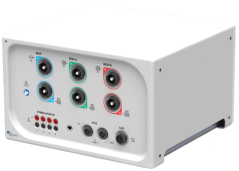
I designed almost all of the analog electronics for a new
medical imaging modality — from blank slate all the way
through human trials. It allows doctors to make physical and
electrical maps of the heart in a fraction of the time and with
much higher accuracy than existing techniques. The system took
measurements on a large number of electrodes on a catheter inside
the heart (nearly 100), and extrapolated the signals on the
heart's surface. The system continued to work during cardiac
ablation with no visible signal degradation (maintaining
sub-microvolt RMS noise floors in the cardiac band in the presence
of 300V peak-to-peak interferer at 500kHz). Some patients are
defibrillated many times during the procedure, so we had to
survive a 5kV spike for about 3ms. The catheter went into the
heart through an incision in the leg, and was threaded up into the
heart. All the signals were cross-coupled, and we had to make
sense of all of that. It's been used in a few thousand surgical
procedures at this point, and has saved a fair number of
lives. The system included what was likely the world's
highest-performance surface ECG as well, which is surprisingly
easy to do (design of ECGs has advanced surprisingly little in the
past few decades). Minor footnote: If you look on Boston
Scientific's web page, they'll rate the noise a good deal
higher. This is mostly because of the funky way in which medical
devices rate noise (which is based on 98th percentile peaks,
rather than RMS).
Bicycle with Custom Handlebars
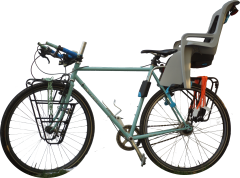
I made myself a bicycle. Or specifically, I bought parts,
and assembled it myself. It's got an internally geared hub, a
Shimano Biopace eccentric crankset, tandem wheels (lacing up and
truing wheels is a Zen kind of relaxing), front and rear rack,
carries an infant, and is generally the toughest, burliest bicycle
you'll see. For better ergonomics, I also welded the handlebars
myself — I held out my hands, and put rods of metal where my
hands most comfortably went. I'm pretty proud of how nice the TiG
welds came out. The inside of the frame is lined with linseed oil,
as are most of the nuts and bolts. The nice thing about that, and
choice of other parts, is I can leave it out in the winter, in
deep snow, in the rain, and all sorts of other conditions, and it
does fine. I can ride on almost flat tires. I don't need to worry
about it. It's spent winters outside, and it's done just fine
(although recently, I did sew a nice cover for it).
Playset
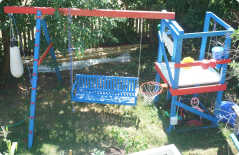
My (2.5-3.5 year old) son and I made a playset! And he
really could help! He did a lot of the painting. He'd place a
square, I'd adjust it and draw a line, he'd centerpunch a hole,
I'd drill it, he'd put a screw in, and I'd screw it. At 2.5, he
could center punch a whole with RMS error of under a
millimeter. Little guy's got a good attention span. It's held
together by structural screws. I actually didn't know those
existed before — I found out when looking for good fasteners
to use which wouldn't corrode in pressure treated wood. Most
screws sheer very easily (and just pull wood together — for
sheer, we use nails or fancy joinery). In contrast, good
structural screws will hold around a thousand pounds each. I aim
for about 10x weight for dynamic vs. static loading, and that's
pretty easy with structural screws. I have large diameter bolts in
just a few places where there may be more extreme stresses. It's
got a swing where we can read books together, a punching bag (he
really wanted after using one regularly at the gym with his mom),
a few climbing structures, and a band set (including a wooden
xylophone).
Wooden Bed with Adjustable Legs and Head
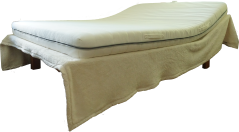
This is my bed. I made two of them, but an ex has the other
one. It's super-sturdy, and the head and feet go up and down. It
also has outlets, so you don't need to run wires all over the
place to power your laptop, cell phone, iPad, etc. in bed. The
frame is 4x4, with 1x4 slats, and a second folding frame on top of
that. It's a bit over-engineered, but that way, (1) it doesn't
shake or squeak at night (2) it has plenty of room underneath it
to vacuum (or for storage) since the legs don't need additional
cross-braces.
Optical Encoder
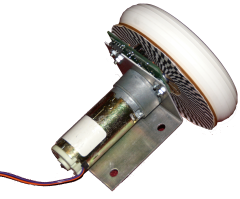
I redesigned the reflective optical
encoders for MASLab. They were fully differential (they
pattern had two strips for each phase instead of one — when
one was black, the other was white, and the circuit compared the
two). As a result, they did not rely on any absolute threshold,
and could be used in a variety of lighting conditions, and with
the reflective surface anywhere from several millimeters to
several inches from the sensor. Perhaps ironically, this is one of
the highest-impact projects I've worked on. It was a very quick
project, but for a long time, it was one of the very few (and the
best) DIY optical encoder designs on-line, and was quite widely
adopted, in all sorts of oddball places (like Hollywood
productions). I've even been asked to review IEEE journal
publication on optical encoders as a result of this — a
field where I'm clearly no expert. The project included a custom
printed circuit board, laser-cut wheel, and pattern.
Autonomous Robot
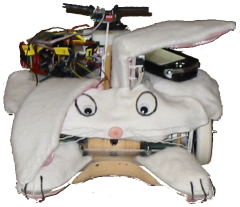
I was on a four-person team for the Mobile Autonomous System
Laboratory at MIT. It is a month-long contest to develop an autonomous robot capable of
completing a task that varies from year to year. Our year, the
goal was to bring back a series of beacons in an unknown
environment. Our robot was the only one to successfully bring back
a target beacon.
Metal+MDF Sewing Machine Table
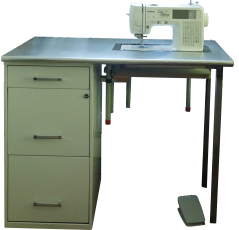
I made a sewing machine table for my sewing machine. The
table top is MDF covered with sheet aluminum. The legs are
oxy-acetylene welded steel. There's also a structure for
raising/lowering the sewing machine, so it sits flush with the
table.
Welded Monitor Stand
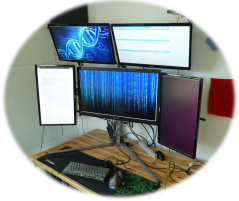
I made my monitor stand by welding a bunch of steel pipes
together with a $100 Harbor Freight flux core welder. Welds are
ugly, by a welder's aesthetic (which also means they wouldn't hold
up hundreds of pounds), but they gets the job done, and they're
not aesthetically displeasing unless you know what a technically
proper weld should look like. There's a 4k monitors in the middle,
surrounded by 1080p monitors, two portrait and two landscape. It
has a little bit of support for clean cable routing too.
Speakers
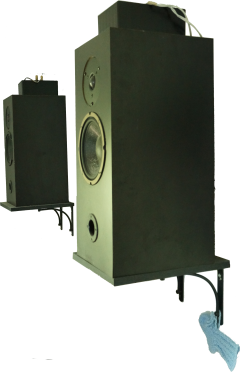
After I took an acoustics class from Bose (the same Bose who ran
the speaker company also taught at MIT), I wanted to apply what I
learned, so I made a pair of speakers. It's a pretty
standard design, except for the external crossover (seen on
top). Using an external crossover lets me (in abstract) put the
crossover before amplification, using lower voltage (and more
linear) components in the crossover.
Classical Breadboarded DC-DC Converter
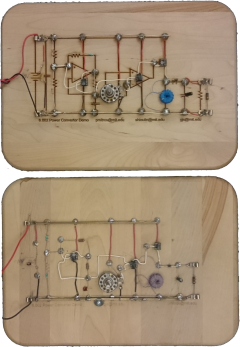
Ever wondered where the term breadboard came from? As it turns
out, people used to prototype electronics by sticking brass tacks
into an actual breadboard and welding to them. This is a demo of a
boost converter made using a modern take on the same
technique. It's for students, so I laser etched the circuit
schematic into the breadboard below the components. After I made
one, a student made another, with a less subtle etching.
Sewing Iron Bag
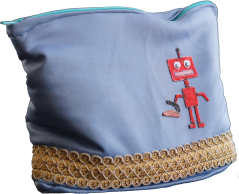
I was given an iron for keeping my clothing creased. I made this
little padded bag for my iron to keep it safe. It's a
simple padded bag. I've made many much like it for my other tools
too. The little robot was CNC-cut.
Turbidistat
I made a turbidistat. What's a turbidistat? It's a device
which measures turbidity to estimate bacterial concentration in a
fluid. If the bacteria get too dense, it pours out some of the
bacteria, and pours in some medium for new bacteria.
Signal Acquisition Package for African Universities
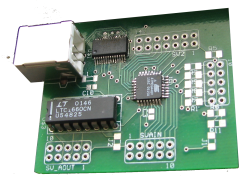
I once made a board very similar to an Arduino, sometime before
the Arduino existed. It has a little more signal functionality in
terms of ADC/DAC. It was designed to be used as a (low speed)
power supply, function generator, and oscilloscope at a university
in Africa.
Fabric Games
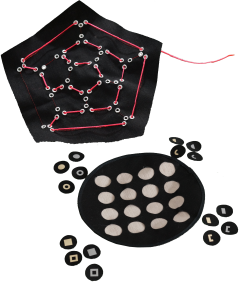
I have a fabric cutter at home. A family member wanted to make a
few puzzles out of wood. I made the same puzzles out of
fabric. One is a connect four style game, where pieces four
properties (hollow/full, color, shape, whole/half). In the other,
you try to find a path which passes through each node once. I make
a lot of things on my fabric cutter. What's need is a project like
this takes something like an hour start to finish. What's not so
neat is that all the fabric cutters have locked-down proprietary
file formats and interfaces.
Bookcase
I made a rather nice bookcase. I was just learning to woodwork, so
it took a rather long time. All of the screw holes have plugs
(wood of the same color above the screw head), so they're almost
invisible. The shelves adjust in height (except for the middle
one). The back is in-set. And the joinery is all rather fancy.
Desk
I made a desk out of an old workbench tabletop and some poplar
legs. I had to replane the tabletop quite a bit. The top is also
routed so it looks like it's floating.
Sheet Metal Speaker Stand
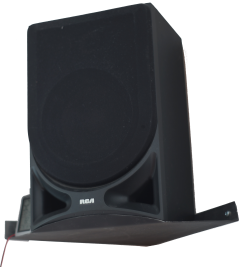
I made some speaker stands out of sheet metal. They're for a pair
of old speakers someone gave me when I was in college.
Quiet Computer
In the late nineties, I was a leading authority on making
near-silent computers. At the time, I slept in a room with a
computer. Computers were noise; it kept me up at night. I found
ways to make it much quieter (which involved things like
retrofitting industrial power supplies, finding/retrofitting
convection heat sinks, using mobile CPUs with desktop motherboards,
finding ways to isolate hard drive noise, etc.). As I recall, I
only broke something once; I had my hard drive spin down when
idle, and it turned out nineties-era hard drives would fail after
a relatively small number of start/stop cycles. I also shocked
myself a couple of times working with open frame power supplies
before I really knew what I was doing (never causing any damage;
120VAC is pretty safe if it doesn't pass through the heart or
perhaps the brain). There were 2-3 major web sites on the topic,
and I ran one. Later, mainstream
manufacturers started paying attention to acoustics, and now there
are many off-the-shelf silent or near-silent computers. If you
want one, you can get something off-the-shelf from Pudget Systems
or similar.
RFID Hack
I made a little device which emulated an MIT ID (specifically,
Jerry Sussman's, with his permission), so I could have access to
MIT after I graduate. This was based on a design by Keith
Winstein, but somewhat enhanced (mostly a nicer form factor
through the use of a planar antenna I designed, rather than a
large coil as Keith used).
VCO Design
I spent the summer of 2004 working for Texas Instruments in India
on VCO design. I'll post more information about what I did there
at some point (I need to sort out what's NDAed).
3d Video Game on an FPGA
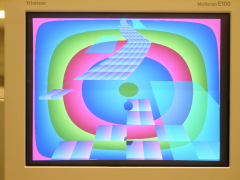
Balkentrol
is a 3d racing video game I designed and built. It's
implemented entirely in hardware (no microprocessor or computer of
any sort; just an FPGA (programmed in VHDL), some DACs, op amps,
solder, wire wrap, resistors, etc.). I implemented this while I
was in 6.111, and turned it into my final project. Later, I was
joined by a partner who built a fancy sound system for the
game. To do this, I had to overclock the FPGA to run at the VGA
dot clock, so the VHDL had to be pretty highly optimized. This
project was nominated by the professors for an award as the top
MIT EECS lab project that semester.
Laser Cutter Art
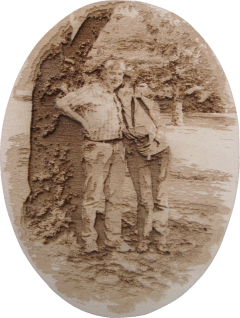
I used to do a fair bit of artwork using a laser cutter. The above
is a picture of my father with his wife cut into a slice of a
tree.
Instrumentation Photosensor
Working for Talking Lights, I designed and built an
instrumentation photodetector, where the noise was dominated by
the shot noise in the photodetector diode (caused by
discretization from individual photons striking the sensor). It
had several MHz bandwidth. It was designed to measure very small
signals on top of a large constant light source.
Assorted Nifty Circuits: Power Converter

Power converter In Roberge's
Advanced Circuit Techniques course, I designed a fairly novel
power converter. It added an idle state to move a zero in the
right half plane into the left half plane, allowing for very high
performance. The initial design, aside from this change, was
over-ambitious in a few other ways (self powering, etc.), and as a
result, I ran out of time, so I ended up implementing a different
design at around the deadline, and finishing the original design a
bit later. A design identical to mine was later independently
published by IEEE Transactions on Power Electronics. I wish I'd
thought to publish it — it Would have been a nice to have a
very early career paper!
Assorted Nifty Circuits: Line Driver

Line driver In Roberge's
Advanced Circuit Techniques, I designed a high speed line
driver. It was a one-shot design (components were chosen to match
each other, and it would not work with randomly chosen parts), but
it had a small signal bandwidth of 60-70MHz, on a protoboard
(about 5x the speed of the fastest project people were aware of
from current and past semesters, and if I recall correctly, and
30x faster than spec). Of course, for large signals, it slew-rate
limited as well (although the slew rate was still very, very
significantly above spec).
Less Nifty Circuits: Other 6.331 projects
6.331 is MIT most intense, advanced analog course for graduate
students. These are my other projects. They met specs, but unlike
the above, were fairly uninteresting in architecture:
- Sample and hold
design — had a trivial DC biasing bug, but otherwise was
fine. Could meet both sets of specs with the change of a capacitor
(we were required to meet either a high-speed or high-precision spec).
- Digital to analog converter
design — completely boring design based on a current-switching
architecture. Had two mistakes in the report (not the design). I
included the wrong version of section 4, which had a spurious
2000pf cap, and I accidentally wrote "potentiometer" in one place
where I meant "resistor"
- Analog to digital converter
design — Flash DAC followed by a bunch of 1 bit DACs. Don't
recall why it made sense to reverse the order and put the flash
DAC at the beginning rather than at the end.
- Phase locked loop lab —
Completely cookbook lab.
Carry-lookahead adder
In 6.374, for the final project, my team designed an adder based on a scheme I came up
with that computed carry for 3 stages at a time, using what was
effectively a DAC and comparator (implemented as a sense
amplifier, with multiple input transistors, with scaled W/L ratios
for the 3 inputs). Good idea? Bad idea? Hard to say, but it was
certainly an interesting idea. The class was fortunately
taught by Tom Knight, who valued creative and interesting
approaches.
Microcurrent Sources
In 6.973 (subthreshold VLSI), I designed a series of microcurrent sources. They worked by
generating a single precision current with a bandgap reference and
an off-chip resistor. This current was converted into an
oscillation frequency (based on a voltage reference and a
capacitor value). The frequency was digitally clocked down, and
converted back to current values (dependent on the new oscillation
frequency, as well as a matched capacitor, and the same reference
voltage). At the time, I had a fairly weak background in control
systems, and as a result, this isn't one of the projects I am more
proud of (this solution, in retrospect, was substantially
underanalyzed, and so likely quite poorly optimized). On the
bright side, the paper was fairly well written.
Audio Visualization Hardware
When my sister came up to visit, we hacked together an analog
audio visualization circuit. We built a beat detector, and drove
the deflection coils of an old CRT from a Mac Plus to draw a
circle that got bigger and smaller in response to the beat.
Function Generator Improvement
The FG500 is an ultra-low-cost function generator. It's also
battery-powered, which is super-useful, since it has no ground
reference. Sadly, it has a nasty DC offset. I modified it to get rid of the DC offet.
Parallel Neural Networks
I spent a summer playing as an intern on the RAW project -- a design
of a 16 core parallel processor designed for fine-grained
parallelism. It was sort of at the intersection of a GPU, an FPGA,
and a multicore processor. I designed a simple neural network which
ran on that processor.
Stupid Machine Vision Prank
I wrote a script which detected when my wife (now ex-wife) came home
which used simple machine vision to detect when the door opened, and
it would greet her from my room. She'd look around trying to find me
and get very confused.... Photos and background here.
Minor Projects
I've got a billion other things I've built, for which I don't have
photos or documentation. On the electronics front, I made a nice
audio power amplifier once (pretty novel control loop). Bitstream
DAC. AM receivers. Misc. DC-DC power converters, linear power
supplies, regulators, etc. Several operational
amplifiers. Temperature probe. Digital FIR filter. FPGA
programmer. Simple switch-cap filter. Etc. On the mechanicals, I
made much of the furniture in my various homes over the years, and
many toys for my son. At the time, I didn't think to take
photos...
Edge Detector on an FPGA
An MIT professor wanted to move machine vision algorithms from a
computer to an FPGA to save power in a flying quadcopter. As a
weekend hack, I build a system which takes video from a camera,
does edge detection, and outputs to a little LCD TV. He offered me
a Research Scientist position doing robotics at MIT. I almost took
it, but ended up starting edX instead. If I'd taken that, I might
now be a highly paid MIT-trained roboticist instead of a
not-for-profit educator!
Garden

I have a garden! Successes this year include tomatoes, radishes,
mint, chives, lettuce, strawberries, mulberries, black
raspberries, and peas.
Graphic Designs
I spent four years on my high school's newsmagazine. I mostly did
graphic design and photoediting. Can you believe I used to be a
pretty good designer? Hard to believe today, looking at my web
page today....
Power Controller
MIT Solar Car I was drafted for a fast-paced 2 weeks to rewrite
the control code for the microcontroller controlling the lithium
ion batteries for the MIT Solar Car team. The folks there wrote
the code, having no working hardware, and left, having never
tested it. As expected, it didn't work, and had a number of minor
and major bugs. I debugged/rewrote it so it worked. I also helped
with soldering, debugging analog electronics, etc. a bit.
Conclusion
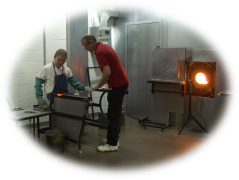
And I'll finish up with a picture of glassworking:
Piotr Mitros: Cultures
Cultures are a bit of a hobby of mine. At this point, I've visited
Jordan, Korea, Mongolia, China, Sweden, Qatar, Israel, Mexico, France, Spain,
Belgium, Netherlands, Canada, Guatamala, Greece, Scotland, Ghana,
Togo, Benin, Costa Rica, Panama, Ukraine, Lithuania, Poland, India,
Nigeria, and the United States. I don't travel much for tourism
— I try to find ways whereby I can embed myself in the cultures,
which mostly means traveling for work, on collaborations, or to visit
friend/family.
At some point, perhaps, I'll take the time to write up all
of these, but for now, I'll give a few highlights.
Nigeria

As a graduate student (although not related to my thesis work), I
spent a few years working on MIT iLabs, a project to develop
laboratories which could be teleoperated from the developing
world. Before my time, this had started as a way to save MIT
students the bother of having to walk all the way from their dorm
rooms to MIT's labs. This may sound frivolous, but it was not. In
electrical engineering, it is important to build intuition for how
mathematical models relate to real-world behavior. Consequently,
engineering students could work with real-world data on virtually
all problem sets, rather than a few times per semester. At some
point, someone noticed such labs could also be used in parts of
the developing world where such equipment was simply not
available. I joined the project and worked closely with Obafemi
Awolowo University in Nigeria. This gave an opportunity to explore
the education system there (often, in way unrelated to iLabs, such
as visiting K-12 schools there), and it's actually where the idea
for edX came from.
OAU was a fascinating place. Just to give a little bit of
context, it's the second best school in a country of more than
half of the population of the US. Nigeria has a reputation as a
rough country — the State Department manages a list of around
30 of the world's most dangerous countries, many being active
warzones, but Nigeria always somehow makes it there. My guidebook
on Sub-Saharan Africa listed, as one of the highlights for
Nigeria, "Making it out alive," and I had my share of
adventures. The students cared about learning, and many of the
faculty were skilled, passionate, and hard-working, but many
constraints — from student-faculty ratio, to availability of
equipment, to curriculum, to student's prior knowledge —
meant students didn't do very well. At the time I visted, and
ex-par from Europe or the US would earn about 50 times as much as
an OAU graduate with a similar degree. As with much of the
developing world, each time I visited, the country was visibly
better than before — better economy, less corruption, and
less crime.
Poland
I was born in Communist Poland, and I continue to visit Capitalist
Poland every few years. This gives a perspective on the evolution
of cultures. I miss many of the changes, living in Massachusetts
day-to-day, since they happen so gradually. Perhaps the most
interesting change in the transition to capitalist democracy was
the rise of materialism. It turned out that having a multi-billion
dollar advertising industry trying to convince people that their
self-worth is defined by what they own has the intended effect.
On the other hand, traditional Polish culture was slightly
negative. For example, the Polish
National Anthem begins with the words "Poland has not yet been
destroyed." Probably the most popular
Polish folk song is about missing Ukraine. Polish culture
became much more optimistic in recent years. I have my own
theories for why that is...
China
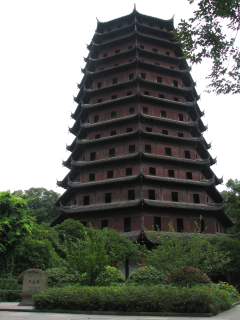
I taught a short 6-week computer science course at Dalian
University of Technology, and later at Zhejiang
University. I also made a whirlwind tour of much of the
country, mostly by train, where I went as far south as spending a
week in village near Xiamen (which has just
installed pipes to bring in water from a nearby river), and going
as far west as Urumuqi (mostly by
trains, usually in the least expensive class, which gives the
greatest cultural exposure).
Ukraine
For a while, I remotely managed an engineering team in
Ukraine. The team built interactive tools for specific disciplines
on edX. We had interactives for letting students do things like
enter crystallography planes, work with chemical equations, or
visualize probability distributions. According to our customers,
the team was quite successful, and many of our customers were
asking to pay for more of their time out of their own funds (this
was in the early days — just as MIT and Harvard had put in
$30 million each — and it would have been unpolitical to
collect money from MIT/Harvard professors, so we did not do this,
or even have mechanisms for doing so). We had morning standups
every day, which became longer meetings if necessary, and I
visited the Ukraine as well. Eventually, edX had a re-org, and the
team went to other managers, and was later dismantled. A few of
the members went on to found RacoonGang, which is now one of the
main three Open edX consulting shops (together with OpenCraft and
ExtensionEngine).
India
I spent three months working for Texas Instruments in Bangalore,
and then made whirlwind tour through Goa, Mumbai, Rajastan, Delhi,
the Himalayas, and Agra. India was my first major foray outside of
Western culture, and I left my heart there. The culture is
tremendously different from the US — more so than any place
I've visited. It's incredibly safe and friendly. And it's easy to
get by on English.
Israel
My grandmother was khassidey
umot ha-olam, so I have relatives there through
adoption. I spent a bit of time there, getting to know my extended
family.
Mongolia
A version of 6.002x was used
in Mongolia when edX was first starting. High school students
at the Sant school successfully finished the course under the
mentorship of Tony
Kim, and it was used at the National University as well, and I
wanted to see how well these worked.
And a map...
And an obligatory map showing the places I've been:
Piotr Mitros: Organizations
Since graduation, I've been involved with three organizations:
edX, Chief Scientist and
Co-Founder (or, Research
Scientist, MIT). Accomplishments:
- Developed one of the top learning platforms in the
world. Platform is free software/open source. Platform has around 10
million users, 200 deployments, 300 contributors, 1000 courses, and
is quickly becoming the predominant education research platform
- Crafted core pedagogy, together with Sussman, Terman, and
Agarwal, which has since lead to very large learning gains in
rigorous evaluations, in both in-person and on-line settings.
- Since, I've lead research and development initiatives around
topics such as educational data mining, learning analytics,
learnersoucing, automated essay grading, peer grading, and
intelligent tutoring systems.
edX has raised over $100 million in funding.
Director of Education, Know Labs
(now Udacity). I (briefly) helped get Udacity
off the ground when they were still Know Labs. Udacity is currently valued at over $1 billion.
Senior Research and Development Engineer, Rhythmia
Medical. My first job after graduation, I was one of their
earlier employees. I developed all of their analog hardware for a new
medical imaging modality from conception to human surgical trials,
including highest-performance ECG circuit in the world. I also helped
with some of the numerical algorithms. Rhythmia sold to Boston
Scientific for around $200 million.
Pre-graduation
Prior to graduation, I worked on voltage-controlled oscillator
design for Texas
Instruments/India, on photodetector design for
Talking
Lights in Cambridge, MA. In addition, I did consulting work
to BCG, helping them incubate a
startup, and later, to that startup. I was saddened when that startup
pivoted, sometime after I left, to become one of the largest spyware
vendors in the world. Otherwise, I had a lot of oddball research jobs
for assorted MIT professors.
In high school, I developed scientific software
for Landmark Graphics
Corporation used by petroleum engineers to help analyze data. I
also had an internship in high school at
the MIT Media Lab.
Piotr Mitros: Teaching Experience
In 2013, I ran a short on-line course known as Maker
Physics. The course focused on on-line pedagogy and physics
education research for physics instructors. These instructors, in
turn, were asked to work together to apply the materials to create
open, reusable digital resources for use in physics courses. This was
together with David Cormier of cMOOC fame. This was one of my many
attempts to crowdsource educational resources.
In 2012, I co-taught MITx 6.002x
with Jerry Sussman, Chris Terman, and Anant Agarwal. This was the
first MITx/Open edX MOOC, and the fourth xMOOC. It was based on active
learning, constructive learning, authentic assessment, immediate
feedback, and rapid remediation of misconceptions. We had 154,763
registrants, of whom 69,221 looked at the first problem set, 26,349
got at least one point on it, 13,569 looked at the midterm, and 7,157
earned the first certificate awarded by MITx. The course was also used
— extremely successfully — in places from state schools to
high schools in Mongolia to on-campus at MIT. 96% of students who
finished (note the sample bias -- but on the upside, reporting rate
was in the nineties) reported it was as good as or better as a normal
residential university course. In a randomized control trial at SJSU,
the course used in a blended setting brought completion rates from 59%
to over 90% (and in future semesters, allowed SJSU students to master
the full MIT course).
In 2011, I helped out with
the Stanford AI
Course. This was the first xMOOC.
In 2006, through CETI, I
co-taught an abridged version of 6.001, MIT's famous introductory
computer science course, at Dalian University of Technology and
Zhejiang University (China).
From 2005-2007, I worked on the MIT
iLabs project, where we developed on-line laboratories for use in
the developing world in close collaboration with Obafemi Awolowo
University in Nigeria. I went to Nigeria three times, as a result, and
saw a few other parts of Africa. I also developed some very low cost
hardware for use in such laboratories, in many ways similar to the
modern Arduino, but with more signal acquistion/generation
capacity.
In 2003, I helped Hal Abelson and Jerry Sussman
make 6.002ex,
a radical revamp of the electronic engineering introductory course
6.002 where students learned circuits and electronics by working
on design projects in small groups under mentors from industry.
I was also involved in assorted teaching-and-learning initatives
in high school, and was a TA for MIT 6.071 and 6.101 as a graduate
student.
Piotr Mitros: Art, Imaging, and Photography
I do a bit of photography, videography, and occasionally, imaging
equipment design. This section is coming!
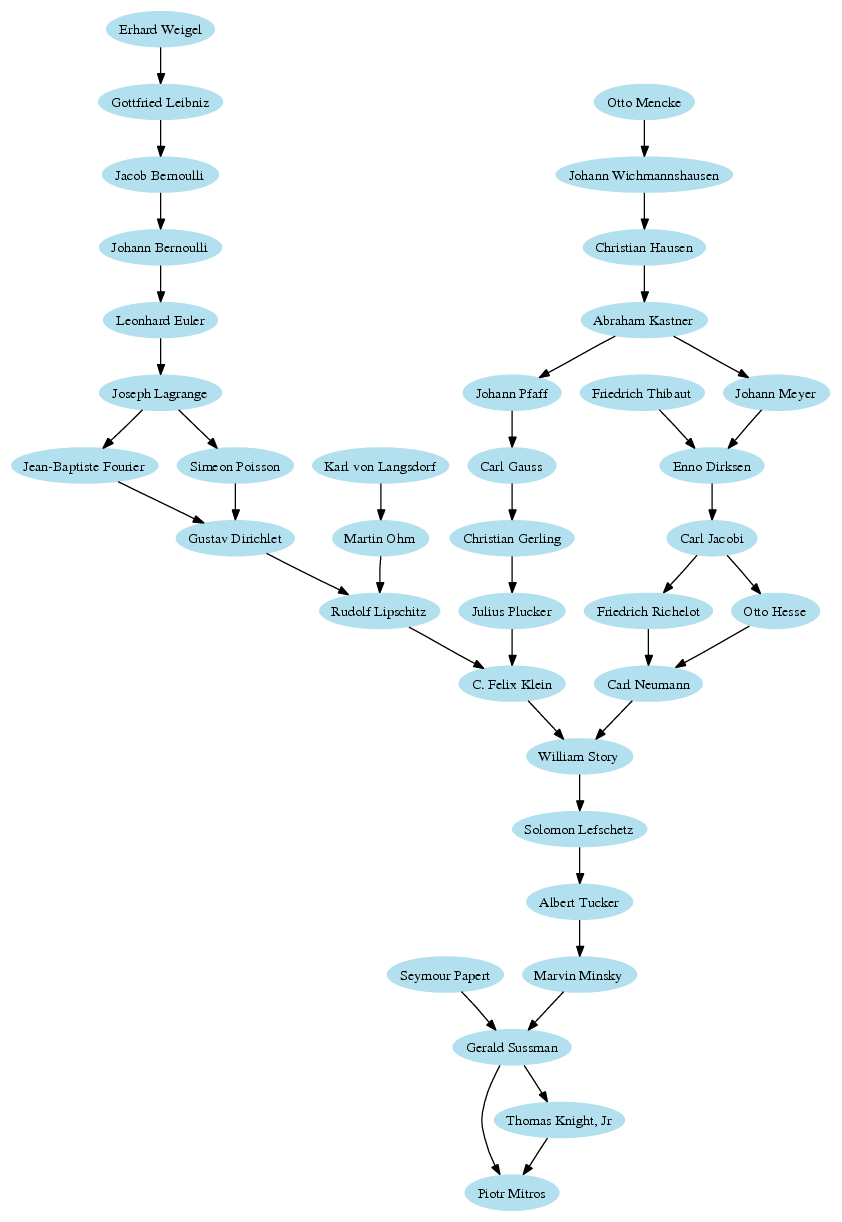
Piotr Mitros: Academic Geneaology
This is a chart of my academic genealogy (showing thesis
supervisor/supervisee relations). The data is primarily from the
American Mathematical
Society's Mathematics
Genealogy Project. The chart was made
with Graphviz, although I had
to rescale the image map with a perl
script. Note that it is an image map -- click on the people, and
you'll go to their Wikipedia pages. The mystery is Seymour Papert. As
far as I can tell, there is no record of who his advisor(s) in South
Africa was/were.
Piotr Mitros: Education
Degrees
- 2007 Ph.D Electrical Engineering, MIT. Advisors: Gerald Sussman and Tom Knight
- 2004 M.Eng Electrical Engineering and Computer Science, MIT
- 2004 B.S. Electrical Science and Engineering, MIT
- 2004 B.S. Mathematics, MIT
As a bit geneaology, Jerry Sussman was co-advised
by Seymour
Papert. Based on my work on Open edX, I tend to get lumped
with instructivist educational technology, but Papert's ideas on
education inspire my work at least as much, as do many
technology-free social constructivist concepts.
Other Certifications
- MOR Associates Advanced Leadership Program
- Scrum.org Professional Scrum Product Owner I
- SSI Open Water Diver
- NauticEd: Qualified Crew Member (Navigation Rules Clinic, Skipper Course, Anchoring a Sailboat Clinic, Basic Sail Trim Course)
- MIT Sailing: Swim, Provisional, Firefly.
- Community Boating: Kayak, Mercury, Windsurfing. NauticEd:
- United Nations: Basic Security in the Field, Advanced Security in the Field
MOOCs on Teaching and Learning
- Applying Principles of Behavior in the K-12 Classroom (Coursera)
- Coaching Teachers: Promoting Changes that Stick (Coursera)
- Early Childhood Education (Open2Study)
- Foundations of Teaching for Learning 3: Learners and Learning (Coursera)
- Foundations of Teaching for Learning 6: Introduction to Student Assessment (Coursera)
- HarvardX GOV1368.1x: Saving Schools, Mini-Course I: History and Politics of U.S. Education (edX)
- HarvardX GOV1368.3x: Saving Schools Mini-Course 3: Accountability and National Standards (edX)
- HarvardX GOV1368.4x: Saving Schools Mini-Course 4: School Choice (edX)
- HarvardX GSE2x: Leaders of Learning (edX)
- ICT in Primary Education: Transforming children's learning across the curriculum (Coursera)
- Instructional Methods in Health Professions Education (Coursera)
- Surviving Your Rookie Year of Teaching: 3 Key Ideas & High Leverage Techniques (Coursera)
- Teaching Character and Creating Positive Classrooms (Coursera)
MOOCs on Business and Law
- HarvardX HLS2x: From Trust to Promise to Contract (edX)
- Human Resources (Open2Study)
- MITx Entrepreneurship 101: Who is your customer? (edX)
- Management for a Competitive Edge (Open2Study)
- Managing People: Engaging Your Workforce (FutureLearn)
- Negotiation and Conflict Resolution (Open2Study)
- Principles of Project Management (Open2Study)
- Strategic Management (Open2Study)
- Subsistence Marketplaces (Coursera)
MOOCs on Engineering
- Pattern Discovery in Data Mining (Coursera)
- Sports and Building Aerodynamics (Coursera)
- TUMx AUTONAVx: Autonomous Navigation for Flying Robots (edX)
- Tenaris Steel101x: Introduction to Steel (edX)
- UPValenciaX: Dynamics and Control (edX)
Other MOOCs
- HarvardX SW12.1X: China (Part 1) - The Political and Intellectual Foundations of China (edX)
- Ideas from the History of Graphic Design (Coursera)
- Questionnaire Design for Social Surveys (Coursera)
- The Emergence of the Modern Middle East - Part I (Coursera)
- The Horse Course: Introduction to Basic Care and Management (Coursera)
More Interesting Classes
EE: Advanced Circuit Techniques (6.331), Subthreshold Analog VLSI
(6.973), Analysis and Design of Digital Integrated Circuits (6.374),
Design of Analog MOS LSI (6.775), Integrated Microelectronic Devices
(6.720), Solid State Circuits (6.301), Computer Architectures (6.823),
Unusual Computer Architectures (6.911). (Undergrad coursework not
listed)
Graduate signals, systems, and controls coursework: Feedback
Systems (6.302), Wavelets and Filterbanks (18.327), Dynamic Systems
and Control (6.241) (Undergrad coursework not listed)
Graduate CS coursework: Seminar in Theoretical CS (18.419),
Approximation Algorithms (6.891) (Undergrad coursework not listed)
Mathematics: Discrete Math (18.062), Analysis I (18.100), Analysis
II (18.101), Fourier Analysis (18.103), Linear Algebra (18.700),
Algebra I (18.701), Algebra II (18.702), Topology (18.901), Grad
Probability (6.431) (Common calculus classes not listed)
Physics: Waves (8.03), Statistical Mechanics (8.044), Introductory
Special Relativity (8.20), Advanced Classical Mechanics (8.351J),
Quantum Computation (18.435J) (Intro physics not listed)
In addition, I have taken a number of classes in economics, a
couple in business and technology law, and a couple on crosscultural
communications.
Expired Certifications
Amateur radio operator
CPR
Piotr Mitros: Personal
I was asked why I don't have more personal information on my web
page. I do have quite a bit, actually. You just need to find
it. For the most part, my life consists of writing code, starting
businesses, making things, traveling, trying to make the world a
better place, and spending time with my friends and family. I
don't say too much about my friends and family (I respect their
privacy), but otherwise, all of that is pretty well represented
here. And in many cases, where I went, what I built,
and why does tell a lot of my story and who I am.
And to keep in mind I
have a
dry sense of humor. To the best of my knowledge, all parts of
this page are true. However, a few are not quite serious (and
indeed, one or two as social commentary). A few of the
not-so-serious ones only come out on a close reading or
a very close reading. Which, I suspect, no one will ever
do. But then, it is my personal web page, not yours.
Mitros Consulting
I do consulting, talks, and assorted freelance work. Areas of past
services have included:
- Learning engineering, blended learning models, online learning,
evidence-based education, and educational technology
- Electronics engineering including medical device
design
- Programming services
- Applied mathematics of different sorts (e.g. machine vision,
signal processing, control systems, and machine learning)
- Business consulting, especially focused on disruptive business
models in areas like education
- In the past, I've provided limited photographic and audiovisual
services
A fair amount of my consulting work has been international. In
particular, I have experience working in developing settings
(e.g. Sub-Saharan Africa, Middle Eastern refugee camps, India,
etc.).
I prefer work which is free, open, and makes the world a better
place, and where I can talk about my work and to see it broadly
adopted. I also don't protracted negotiations, discussion, or
complex logistics. As a result, my rates depend on:
- How intellectually interesting the project is
- Social impact
- Openness and transparency
- Visibility
- How much I'll learn
- Overhead
So far, I've balanced low-paid, open work with high social impact
(for example, education in refugee camps) and high-paid proprietary
work (mostly in applied mathematics; machine vision, machine
learning, and similar areas are in high demand these days).
If you have an interesting project, please get in touch!
About this page
Ah, you're looking at the HTML of this page? Fine choice. A person
of style.
This page is intentionally a very simple web page. It uses just
CSS and HTML5. Much of it is auto-generated (mostly from my CV, my
github repos, as well as projects from older pages). It has just three
lines of JavaScript, so if you go to the page with a non-existent
anchor, it will take you to the bio page. My previous page was HTML2.
I find HTML2/HTML5 more elegant to work with than 3/4 or JavaScript.
(I do permit a little bit of JavaScript for the country map; not
mine own)
And a lot of the page, also intentionally, follows SGML rather
than XML, a la HTML2. In particular, SGML specifies rules —
which browsers seem to follow — about omitted closing tags for
elements such as paragraphs and list items. That just makes for
cleaner, more human-friendly text.
Right now, it needs styling. It's very, very ugly, unfortunately. I went
with defaults of:
- The serif font is
Merriweather.
The san-serif is OpenSans. Both (approximately) match. They have
a similar x-height (Merriweather is, unfortunately, a little bit
higher). Merriweather is mch more modulated, and a little bit
heavier. I'd like a slightly lower x-height. Even though it's
for display use, the high x-height takes away from the
refinement of the page. If I have a chance, I'll find better
matching fonts. The look I want would be best suited to a
transitional serif such as Baskerville or Caslon, to give a more
academic look, with a matching sans serif.
- The colors are from a generic color matching tool. I'd like
classic colors -- very sapia, or old document looking. That's
not quite what I have, but it's the best the tool could do. If I
went into old parchment colors, the tool would spit out pretty
wild ones for complements.
- The autogeneration also leads to some style
inconsistency. It's not fundamental — it could be fixed with
more/better logic in the autogeneration.
- And there is still a11y, responsiveness, etc. fixes possible
I should also sort out a lot of the obsolete/undergrad stuff from
the current more interesting things.